About Multimedia
Multimedia
The changing face of technology has taken humankind into an entirely new era, the “information age”, and the ability of state-of-the-art electronic tools to gather, refine and shift data have opened new vistas for data presentation. Presentation applications involving imaginative use of “multimedia” allow for new and more powerful and personalized modes of representing data.
Computer-based,interactive applications having multiple media elements.
- text
- graphics
- animations
- video
- sound/Audio
For example, a presentation involving audio and video clips would be considered a "multimedia presentation." Educational software that involves animations, sound, and text is called "multimedia software." CDs and DVDs are often considered to be "multimedia formats" since they can store a lot of data and most forms of multimedia require a lot of disk space.
Multimedia System
A multimedia system is characterized by computer-controlled, integrated production, manipulation,presentation, storage and communication of independent information,which is encoded at least through continuous (time-dependent) and a discrete (time-independent) medium.
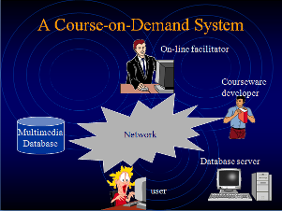
Components Of Multimedia System
Now let us consider the Components (Hardware and Software) required for a multimedia system:
Capture devices - Video Camera, Video Recorder, Audio Microphone, Keyboards, mice, graphics tablets, 3D input devices, tactile sensors, VR devices. Digitising/Sampling Hardware
Storage Devices - Hard disks, CD-ROMs, Jaz/Zip drives, DVD, etc
Communication Networks - Ethernet, Token Ring, FDDI, ATM, Intranets, Internets.
Computer Systems - Multimedia Desktop machines, Workstations, MPEG/VIDEO/DSP Hardware
Display Devices - CD-quality speakers, HDTV,SVGA, Hi-Res monitors, Colour printers etc.
